
Categories
Arts & Humanities Geography STEM

The uses & consequences of pesticides and the viability of alternatives

This article was written by fifth-former Janek Czarnek, and provides a shortened abstract of his original essay titled: “The Use of Pesticides: Beneficial or Detrimental”. To view his complete article, click the link at the end.

Estimated read time: 4 minutes

The Uses and Consequences of Pesticides and the Viability of Alternatives

            It is clear that pest protection is key to agricultural sustainability globally, which is now more important than ever, as with a rapidly growing human population the demand for food is only becoming greater. It is estimated that between 26% and 40% of the world’s crop yield is lost each year due to pests, and this could rise up to 52% to 80% without the use of crop protection (1). Pesticides are chemical compounds used to kill pests, which can include any destructive organism that is a vector of disease or attacks crops or livestock. Not only are pesticides effective, at least in some circumstances, at directly eliminating the threat of pests, but they can also have secondary benefits such as preserving soil quality (1). However, although pesticides may be effective in some circumstances, their true long-term effectiveness and the consequences that they impose on non-target plants and animals pose an important question about their suitability for continued usage. Pesticides can have devastating consequences on non-target organisms and biodiversity, especially on fish where upon entering water sources can kill many fish through acute poisoning or oxygen depletion (2). Considering these effects on biodiversity, alongside increasing resistance to pesticides due to their great usage, are pesticides an effective long-term solution? Are they beneficial or detrimental to us, humans, and non-target plants and animals?

            Although there are many consequences to pesticide usage, one cannot forget the crucial role they play in crop protection that serves benefits both for food and biofuel production, as well as in disease control and infrastructure maintenance. A full evaluation of how pesticide usage should change in the coming years must consider how their impacts can be mitigated and whether there are viable alternatives that can effectively protect crops on the scale needed.

            Firstly, it is important to note that in some cases the consequences of pesticide usage can largely be mitigated through more careful, and even more regulated, application of these chemicals in a way that is less impactful on the surrounding ecosystems and organisms in addition to those who apply them. Mitigations of the consequences of pesticide use can include simply reading and following labels more closely (3), or using pesticides that do not leach and using more direct application rather than spray application to reduce pesticide drift and subsequently reducing the effects on surrounding ecosystems (3). Farmers can also be advised to leave a ‘buffer zone’ of crops around the edges of fields and agricultural land where pesticides have been used in order to reduce the chance of non-target plants and animals coming into contact with the pesticides (3). Responsible pesticide application can also include taking into consideration the surrounding geography as well as the weather; pesticides should be applied in dry conditions where rainfall is not forecasted because this prevents leaching and surface-run off water carrying the pesticide chemicals away and potentially affecting non target organisms (4). Similarly, pesticides should be avoided where the temperatures are high and when plants are suffering drought as this will increase the rate of transpiration where pesticides can dissolve into water and be dispersed (4). Many other precautions can also be taken; however, it is important to realise that many of the damaging consequences of pesticides can be reduced by taking actions considerate of the surroundings and using them responsibly.

Figure 1 Rice-Fish Culture in China, FAO, http://www.fao.org/giahs/giahsaroundtheworld/designated-sites/asia-and-the-pacific/rice-fish-culture/en/

           On the other hand, safer alternatives that can still effectively protect crops are always preferable. Many of these alternatives come under the branch of organic integrated pest management, which includes several methods to control pests in an environmentally sustainable manner (5). An important part of this is effectively preventing pest populations growing in large numbers through methods such as companion planting, where plants that repel certain insects are planted, and biological control, where natural predators are introduced to organically control pest populations (6). An example of introducing natural predators is that of utilising ladybird larvae which are effective at managing aphid populations (6) or other symbiotic relationships such as that of fish in rice fields where fish will eat the pests attracted to the rice (7). In Bangladesh it was observed that pest infestation in rice fields containing only rice were 40-167% higher than those that also contained fish (7). Preventive measures can also be combined with increased monitoring of pests and mechanical pest control through means such as fences and nets to reduce access of pests to crops. Alternative chemical means to protect crops have been developed through genetic modification; for example, the genomes of maize and cotton have been altered to include genes that make the plant toxic to pests and hence protect themselves and the surrounding crops (8). All these methods can greatly reduce the impact that pesticides have on biodiversity, the recent Global Biodiversity Outlook 5 indicated that none of the 20 Aichi Biodiversity targets had been reached in the last decade (9) and the Living Planet Report 2020 has said that between 1970 and 2016 there has been a 68% decrease globally in populations of mammals, amphibians, birds and reptiles on average (10); this is up from 60% in 2018 when looking at the period 1970 to 2014 (11).  Considering these many alternatives to protect crops from damage from pests, and the need now more than ever to do everything we can to stop reducing global biodiversity, it seems clear that action should be taken to increase the usage of these alternatives that greatly reduce the impact on non-target organisms.

            Therefore, in conclusion, pesticides used for agricultural crop protection and other uses with exposure to the surrounding environment are detrimental and have far reaching consequences throughout ecosystems, on both plants and animals, as well as for ourselves. Although pesticides also have important benefits, these will become less effective in the future and can be replaced by alternatives that pose significantly less danger to us and non-target organisms. Moving forward we must ensure that the transition to these safer alternatives is carefully managed, so that they do not affect the availability of food and ensure that they can be provided on the necessary scale. Although this transition may take time, it is clear that pesticides do not have a place in our long-term solution for crop protection from pests and are overall more detrimental than beneficial.

To view Janek’s full article, follow this link below.

Bibliography      

1. OECD/FAO (2012). OECD-FAO Agricultural Outlook 2012-2021. Paris : OECD Publishing and FAO, 2012. https://doi.org/10.1787/agr_outlook-2012-en..

2. Fishel, Frederick M. Pesticide Effects on Nontarget Organisms. EDIS University of Florida IFAS Extension. [Online] [Cited: 7 October 2019.] https://edis.ifas.ufl.edu/pi122.

3. United States Environmental Protection Agency (EPA). Tips for Reducing Pesticide Impacts on Wildlife. EPA.gov. [Online] [Cited: 9 July 2020.] https://www.epa.gov/safepestcontrol/tips-reducing-pesticide-impacts-wildlife.

4. The Royal Horticultural Society (RHC). Chemicals: using them in gardens. RHS.org.uk. [Online] [Cited: 9 July 2020.] https://www.rhs.org.uk/advice/profile?pid=817.

5. United States Environmental Protection Agency (EPA). Integrated Pest Management (IPM) Principles. EPA.gov. [Online] [Cited: 9 July 2020.] https://www.epa.gov/safepestcontrol/integrated-pest-management-ipm-principles.

6. Spence, Steven. Gardening Alternatives to Pesticides. Science Connected Magazine. [Online] 2017. [Cited: 9 July 2020.] https://magazine.scienceconnected.org/2017/07/gardening-alternatives-pesticides/#:~:text=%E2%80%9CSoft%E2%80%9D%20chemicals%3A%20soap%2C,pest%20infestations%20in%20short%20order..

7. Halwart, M. and M.V., Gupta (eds.). Culture of Rice in Fish Fields. s.l. : FAO and The WorldFish Center, 2004. [Cited: 9 July 2020.] http://www.fao.org/3/a-a0823e.pdf.

8. GeneWatch UK. Pest Resistent Crops. genewatch.org. [Online] [Cited: 9 July 2020.] http://www.genewatch.org/sub-568238#:~:text=Pest%20resistant%20crops-,Pest%20resistant%20crops,bacterial%20species%20called%20Bacillus%20thuringiensis..

9. Secretariat of the Convention on Biological Diversity. Global Biodiversity Outlook 5. Montreal : s.n., 2020.

10. WWF. Living Planet Report 2020 – Bending the curve of biodiversity loss. Gland, Switzerland : s.n., 2020.

11. WWF. Living Planet Report – 2018: Aiming Higher. Gland : s.n., 2018.

Table of Figures

Figure 1 Rice-Fish Culture in China, FAO, http://www.fao.org/giahs/giahsaroundtheworld/designated-sites/asia-and-the-pacific/rice-fish-culture/en/ 2


Categories
Arts & Humanities English

Ways of Seeing

This article was written by Dr McEwan of the RGS English Department

Estimated read time: 6 minutes

Given the necessity for screens during blended and remote learning what follows is a discussion of how seeing is always framed in particular ways. 

Dr McEwan – English Department 

According to Anne Friedberg ‘how the world is framed may be as important as what is contained within that frame’ (2006: 1). To comprehend how ways of seeing are always framed in certain ways it is necessary to look at how the frame has evolved. To do this one must go back to one of the earliest forms of frame, the window. If we take the window at its literal meaning we discover that the window is an opening, an aperture for light and ventilation and that it also provides an opportunity to look out onto the three-dimensional world beyond it. A window shows what is physically beyond the pane of glass, yet it is ‘also a frame, a proscenium [and] its edges hold a view in place’ (Friedberg, 2006: 1). As such the window provides a seemingly extensive view of what is beyond it, but it does in fact limit the visual scope of the viewer. When viewing a window in terms of its frame as a boundary we can draw many parallels between other cultural objects. At its most basic definition, as an ‘opening in architectural space’ (Friedberg, 2006: 5), the window automatically supplies us with a common metaphor for the various frames that form the frame of a painting as well as of movies, televisions, and computers. By examining the window, and its gradual architectural evolution into the screen, it will be possible to determine just how ways of seeing are always framed in certain ways. 

Leon Battista Alberti argued that a painting could be seen ‘as an open window through which the subject to be painted is seen’ (cited in Friedberg, 2006: 27). Rather than speaking of a painting as an image that is painted onto a canvas ‘Alberti invokes the image of the window as an instructive substitute for the rectangular frame of the painting’ (Friedberg, 2006: 12). The result of this is that rather than the window being one thing and the painting another they lend meaning and substance to the other until the relation of images is bidirectional. In other words, the window is like a painting as it frames an opening onto the world and the painting is like a window as the painter frames the view as if it were being viewed through a window. This is the basis for Alberti’s argument that the window is predominately used as a metaphor for the frame as it creates a certain set of relations between a fixed viewer to a framed view. The crux of Alberti’s argument was to use the window ‘not as a “transparent” “window on the world”’ (Friedberg, 2006: 12) but rather as a device to focus on the frame that surrounds that window.  

Often disregarded are the everyday frames through which we see things such as the “material” frames of movie screens, television sets, computer screens, and car windshields. It is these frames that usually go unnoticed that ‘provide compelling evidence of the dominance of the frame and its visual system’ (Friedberg, 2006: 13-14). There are now many more possible ways to frame images, whether ‘projected on a large screen, transmitted via broadcast, cable, satellite, or seen on computers, portable DVD screens, or stream[ed] online’ (Friedberg, 2006: 4). Along with the beginning of the projected image a new form of spectatorship was formed, although the basic model was still adhered to, that of the immobility of the spectators and the aperture of a fixed frame. This meant that although the moving image was confined to a frame it ‘provided a virtual mobility for [the] immobile spectators’ (Friedberg, 2006: 5). Rather than a window being the barrier it is the frame that ‘becomes the threshold – the luminal site’ (Friedberg, 2006: 6). Within this particular frame it is possible to be shown an ever increasing array of images and as such the screen has replaced the window in terms of prominence. Screens have become a fixed feature of daily life, buildings are adorned with screens as exterior walls computers interface with other screens and phones take and transmit photos. As well as fixed screens mobile screenic devices have added mobility to the screen’s face in the form of objects such as mobile phones, ipods and now Surfaces. As we shall see it is evident that the window has become a metaphor for the screen and conversely the screen has become an actual substitute for the window. 

It is when talking about computer screens and similar technologies that the metaphor for the window becomes blurred as the window in ‘computer software relies on a different set of assumptions’ (Friedberg, 2006: 1). Rather than the window being used to talk about the computer screen it is used to refer to a ‘subset of its screen surface’ (Friedberg, 2006: 1). This difference when talking about computer technologies is also made apparent in the fact that ‘the Microsoft version of windows has in many ways overtaken its architectural referent’ (Friedberg, 2006: 3). As each new media is introduced there is an attempt to link it to more familiar language with the hope that wrapping the newly strange in the familiar language of the past will render the new cultural object less strange. It was in this way that screens became a ‘component piece of architecture, rendering a wall permeable to ventilation in new ways: a “virtual window”’ (Friedberg, 2006: 1). Yet, on a computer screen it is possible to have open a multitude of individual windows with each one contained within its own frame. A result of this is as the beholders of multiscreen “windows” we now receive images in spatially and temporally fractured frames. Friedberg asserts that this way of framing is both postcinematic and posttelevisual, and yet remains within the delimited bounds of a frame and is still seen on a screen (2006: 7). In other words, no matter how advanced the technology the frame will always be visible as the boundary between what is seen through the window or shown on the screen and what is on the outside of that frame. 

However, we can also consider situations where the frame is more abstract than this. Drawing on film as an example Friedberg states that ‘[t]he frame functions for the film as the field of our bodies does for us’ (2006: 16); if this is the case then it is vital to consider the affects that framing has on the identity of an individual. As we can see from Sturken and Cartwright’s arguments within consumer culture windows are present most dominantly in the form of shop display windows as ‘[s]tores [are] designed with an emphasis on the visual display of goods’ (2001: 194). The shop front plays on the most basic desires of the consumer in that ‘[w]hat one can see in the light of day is always less interesting than what happens behind a pane of glass’ (Charles Baudelaire cited in Friedberg, 2006: 5). Following on from this view we need to consider precisely what message comes through a window to the consumer. People are no longer identified by where they were born but by what they consume, and as such consumption has become about constructing an appropriate identity for ourselves. When viewing products through a shop window the objects on display are both framed and placed behind the physical barrier that is the window itself. Yet, unlike with a painting or a screen it is possible to pass through that barrier and to immediately obtain what we desire. As a result of this shopping has become a key leisure activity where the consumer buys things because they are wanted and not because they are needed. The commodities we purchase frame us as they will ‘become part of one’s self-identity and how one projects that self into the world’ (Sturken and Cartwright, 2001: 198).  

It is essential to remember the frame as it is often forgotten completely in favour for what is contained within it. According to Hubert Damisch ‘“our period is much more massively informed […] thanks to photography, film and now video, than was the fifteenth century’ (cited in Friedberg, 2006: 2) and as such we cannot ignore the frame as it is ever present within all these technologies. Wittgenstein stated that ‘“[t]he limits of [our] language are the limits of [our] world”’ (cited in Friedberg, 2006: 7) and Friedberg extends this to encompass the idea that the limits of our frames of vision determine the boundaries of our world. Therefore, it is not only in technologies such as computer screens, television and movie screens where framing can be considered, ways of seeing are also framed within the identity of the person doing the viewing. It is due to ways of seeing always being framed in certain ways that the viewer is left ensconced behind the window and as such is relegated to the role of ‘spectator against a world which becomes a spectacle’ (Romanyshyn cited in Friedberg, 2006: 16). 

Bibliography

Friedberg, Anne (2006) The Virtual Window: From Alberti to Microsoft, Cambridge MA: Massachusetts Institute of Technology Press 

Keenan, Thomas (1993) ‘Windows: of Vulnerability’ in Bruce Robins (ed.) The Phantom Public Sphere, London: University of Minnesota Press, p. 121-141 

Sturken, Marita and Lisa Cartwright (2001) Practices of Looking: An Introduction to Visual Culture, Oxford: Oxford University Press    

Categories
Arts & Humanities English Poetry

What Colour is the Moon?

This poem was written by upper sixth-former Hugh Jones

Estimated read time: < 1 minute

What colour is the moon?
Our language reaches, but falls short of  
Grasping that ephemeral beauty, 
Too sublime to be caught in words. 

What colour is the moon? 
Grey? Yes grey, but richer than a single hue; 
Rather a thousand, layered with majestic artifice 
– With halo celestial the pale disk crowned. 

What colour is the moon? 
White? Yes white, but not so innocent, 
Carrying a darker beauty, deliciously marred- 
Tainted by the sins indulged in her light. 

What colour is the moon? 
Silver? Yes silver, yet unlike that imperial spoil, 
The celestial orb hangs beyond grasping man’s  
Grasping tongue, indescribable, and thus, unconquerable. 

By Hugh Jones 

Categories
Arts & Humanities Economics Geography Social Sciences

An analysis of the global north south divide

Runner up for the Cambridge Society for Economic Pluralism essay competition, written by upper sixth-former Jack Donnelly.

Estimated read time: 11 minutes

The Global North is rich largely due to exploitation and underdevelopment of the Global South, which still goes on to this day, and therefore owes reparations to rectify this rift. Discuss.

Murmurs of discontent spread throughout the former colonies. In July 2020 this went beyond mere whispers as the Democratic Republic of the Congo demanded compensation for the pain inflicted by decades spent under colonial rule. Just a month later, Burundi laid the same demands at the feet of Belgium and Germany – to the tune of $43 billion. There’s no doubt that a massive proportion of Sub-Saharan Africa’s – and indeed the Global South’s – modern troubles come courtesy of their exploitation under the Global North; the question emerges, do the modern nations owe reparations for crimes committed centuries ago?

The Global North is an oft-cited idea which, in reality, lacks clear boundaries or uniting principles. For one, the conceptual Global North ignores the geographical parameters implied by the name – it is not simply a conglomerate of nations existing above the Equator or, indeed, some agreed latitude. Therefore, before discussing the Global North-South divide we must establish what the Global North actually describes. The Brandt Report of 1980 gave economists and politicians an idea of the immense gulf in development between the two hemispheres; more importantly, it gave us the ‘Brandt Line’ which depicts the divide based on GDP per capita as a factor. Notably, it straddles the Earth at 30o N but drops to include New Zealand and Australia as part of the Global North. Brandt himself was optimistic for the new century and that coordination between the hemispheres could ‘build a world in which sharing, justice, freedom and peace might prevail’. 

In another sense, the geopolitical North-South divide was highlighted in Alfred Sauvy’s Trois Mondes, une planète where he coined the terms First, Second, and Third World. The phrases were originally instituted for the USA and the USSR and their respective allies, along with the unaligned Third World – a term now synonymous with poverty and underdevelopment, rather than a particular political alignment. Today we like to characterise the divide through a number of developmental factors: income inequality, wealth, democracy indices, along with political and economic freedom.

Regardless of how you categorise the divide – it is most certainly there. Examining its extent, the North earns four-fifths of the world’s income while constituting less than a quarter of its population; additionally, at least up until the early 2000s, over 90% of global manufacturing took place in the North. Interpreting the level to which exploitation has brought about the current situation could allow a conclusion to be reached on whether reparations are truly owed. 

The most obvious example of historical Northern exploitation of the South is colonialism – it’s simply inescapable. Initially, it came commercially, through companies such as the British and Dutch East India Companies[1] which grew to dominate the economies of their respective subjugated nations. At its height, the East India Company accounted for over 50% of global

trade and acted with the sovereignty and jurisdiction of a self-governing nation. The global mechanism of colonialism was analogous to that of a catapult. The colonial powers of Western Europe played a major role in the deindustrialisation of non-Western societies; British intervention in the Indian subcontinent reduced its share of global GDP from almost a quarter to just a couple of measly percentage points as shown in Figure 2. The metaphor completes itself in the way colonialism catapulted Western powers to global superiority through the exploitation of their colonial subjects.  

Nothing is a more egregious act of exploitation than the Atlantic Slave Trade existing between the sixteenth and nineteenth centuries. Briefly ignoring the horrific brutality and the dehumanising nature of the slave trade, we can identify it as the catalyst for so many demographical and economic issues facing Africa today. Some 12 million Africans were captured and shipped out – primarily to America – by the Europeans, destroying their social fabric and depleting the workforce immensely. The poorest parts of modern Africa share a direct correlation with the areas where the most slaves were taken. The scars of colonialism are visible to this day; African nations were created from thin air, ignoring cultural or geographical divides and instead opting for arbitrary borders which have incited enormous amounts of conflict – both national and international – since. 

Even beyond exploitation in its most explicit forms, the colonial powers of Western Europe capitalised on their supremacy by taking further advantage of unfair trade. Through ‘gunboat diplomacy’[2], they forced many countries which had escaped colonisation to sign unequal treaties, leaving the nations bereft of tariff autonomy. To understand the impact of this, we must examine the strength of protectionist policies in young economies. Alexander Hamilton argued in his 1791 Report on the Subject of Manufactures that the US needed to defend

‘industries in their infancy’ from cheaper imports in the more competitive and developed international market. By stripping young economies of ‘infant industry protection’, the powers of the Global North deprived many Latin American and Asian countries of a fair chance at development. Many of these treaties lasted for decades – even well into the twentieth century in some cases. The affected Southern countries experienced negative per capita income growth during the late Industrial Revolution period; an inability to nurture and promote their youthful industries contributed immensely. 

While the level of ‘exploitation’ today does not even hold a candle to its heights in colonial times, forms of neo-colonialism exist between powerful modern countries and the ‘Third World’. China is exercising its financial might – through FDI[3] – across the entire continent of Africa, moulding it into essentially a ‘China’s China’; in this case, however, the development is not necessarily one-sided. The truth is that China is richly compensating African nations as they surge forwards with rapid urbanisation in the ‘fourth industrial revolution’[4]. Daan Roggeveen, the founder of an Architecture firm and an author of books on Chinese and African

Urbanisation, said ‘right now you could say that any big project in African cities that is higher than three floors or roads that are longer than three kilometres are most likely being built and engineered by the Chinese. It is ubiquitous’. Africa is sitting on a massive stockpile of natural resources and China has been quick to take advantage of the power vacuum in the wake of departing colonial powers. China itself is still considered a part of the Global South, but in essence its actions in Africa are reminiscent of historical Northern intervention. Indeed, there have been cries of exploitation and Chinese imperialism, with the former governor of Nigeria’s central bank criticising their removal of natural resources without any provision of economic enrichment in the form of skills and jobs. Regardless, Africa benefits in some sense from the massive amounts of FDI – something one could consider a form of economic reparation. 

Conversely, a significant portion of the North’s success can be attributed to their intrinsic development. Throughout history, a correlation can be identified between the quality of institutions, the strength of government and more advanced economic development. These are elements of a country which can be built up naturally over time; alternatively, they can be instigated by colonisers or conquering foreign powers. School enrolment and greater provision of public goods, for example, contribute a powerful multiplier effect to development. It could be argued that the Global South has not arrived in its disadvantaged position as a result of exploitation, but instead due to unfortunate geography, climate and numerous other factors. 

The Global South has, beyond this, suffered from factors exogenous to the influence of the North. Geography is key to this argument – Africa and South America have been disadvantaged greatly due to their narrow orientation; Eurasia benefits from wide, vast plains of arable land perfect for cultivation and the domestication livestock. A lack of genetic immunity in the ‘New World’ led to the decimation of native populations throughout the continent; immunity that

European settlers had from centuries of close integration with livestock – something native Americans never had. Ultimately, the resulting underdevelopment cannot be pinned on European settlers; they could never have foreseen the devastation they would reap on the relatively immunocompromised natives. The blame here falls upon the poor geographical starting points of Southern societies.

Furthermore, Modernisation Theory attempts to explain the underdevelopment of the Global South as a result of their own policies and socio-economic structures rather than Northern intervention. Feudalism, tribalism and relatively primitive economic structures have led their societies to a point where they lack regulation, democracy and have failed to modernise and develop themselves. The theory considers Third World society largely responsible for its own poverty. The archetypal societal approach tends to grant too much power to individuals; corruption in a country’s elite leadership can obviously be enormously detrimental to development – but it is all too prevalent. 

The Global South now has its own mechanisms in place which, certainly in part, negate the need to have reparations paid by the North. One of the most notable institutions representing the spirit of the developing Global South is the BRICS[5], a multilateral group of major emerging Southern economies. Between them, they constitute 41% of the global population and approximately 23% of world GDP. The BRICS have two key components to their financial architecture which are dedicated to the development of the Global South, the New Development Bank (NDB) and the Contingent Reserve Arrangement (CRA). The bank, in particular, aims to lend up to $34 billion annually with a focus on massive infrastructure development. When outlining the plan for the organisations, the BRICS found themselves keen to distance Southern investment from the North’s sphere of influence; since they are willing to offer competitive rates to their Southern associates, perhaps they are best left to collaborate without the need for Northern intervention or reparations.

Moreover, we are obligated to question the feasibility of reparations being paid by the North. Multilateral payments of any kind are notoriously difficult to agree upon, as could be witnessed with the days of debate over collective debt[6] assumption in the EU in response to the Coronavirus Pandemic. Now consider the complexity of any agreement that would require payment by the collective ‘North’ to the collective ‘South’ on the basis of centuries of

exploitation and mistreatment. Even if it were decided that the current Global North needed to be held responsible for the actions of past generations, the practicality of it dispensing payments or other forms of compensation is contentious at best. Perhaps the more effective method of extending the olive branch would be through bilateral – rather than multilateral – action and intervention; individual Northern powers could be responsible for making reparations with the countries specifically impacted by their ventures. 

Ultimately, the statement is true: ‘The Global North is rich largely due to exploitation and underdevelopment of the Global South’ – to a certain extent. While the North has benefited significantly at the detriment of Southern countries, it is unfair to say that their wealth comes largely from exploitation. A significant portion of Northern success came from the strength of their innate development – strong institutions and a focus on societal growth and evolution have built them into successful nations. Regarding reparations, it is apparent that payment from a United North to a United South would be impossibly complicated to arrange; instead, individual acts of bilateral aids between wealthy Northern nations and poorer Southern nations targeting rapid economic and social development could be a far more constructive option.  

Bibliography

Allen, R. C. (2011). Global Economic History: A Very Short Introduction. Oxford: Oxford University Press.

Banerjee, A. V., & Duflo, E. (2013). Under the Thumb of History? Political institutions and the Scope for Action. Annual Review of Economics.

Burundi Joins Congo in Demanding Reparations from Belgium. (2020, August 14). Retrieved from Bloomberg: https://www.bloomberg.com/news/articles/2020-08-14/burundi-demands-43billion-as-reparations-from-colonial-rulers

Chang, H.-J. (2014). Economics: The User’s Guide. London: The Penguin Group.

David, D. (2018). The Almighty Dollar. London: Elliott and Thompson Limited.

Elvin, M. (1984). Why China Failed to Create an Endogenous Industrial Capitalism: A Critique of Max Weber’s Explanation. Theory and Society, vol. 13, no. 3, 379-91.

Europe’s €750bn rescue package sets a welcome precedent. (2020, July 25). Retrieved from The Economist: https://www.economist.com/leaders/2020/07/25/europes-eu750bn-rescuepackage-sets-a-welcome-precedent

Iyer, L. (2007, November 6). Direct versus Indirect Colonial Rule in India: Long-Term Consequences. Harvard Business School Working Paper, 5-51.

Kamarck, A. (1976). The Tropics and economic development; a provocative inquiry into the poverty of nations. The John Hopkins University Press.

Nunn, N. (2007). Relationship-specificity, incomplete contracts, and the pattern of trade. Quarterly Journal of Economics, 569-600.

Ramachandran, S., & Rosenberg, N. A. (2011). A test of the influence of continental axes of orientation on patterns of human gene flow. Am J Phys Anthropol, 515-529.

Rappaport, J., & Sachs, J. D. (2003). The United States as a Coastal Nation. Jounral of Economic Growth, 5-46.

Sachs, J. (2001). The Geography of Poverty and Wealth. Scientific American, 284.

Sauvy, A. (1952). Trois Mondes, Une Planéte. L’Observateur, 14.

The Persistent Underdevelopment of The Global South. (2018, November). Retrieved from

UKEssays: https://www.ukessays.com/essays/economics/the-persistent-underdevelopment-ofthe-global-south-economics-essay.php>vref=1

Warner, A. M., & Sachs, J. D. (2001). The Curse of Natural Resources. European Economic Review, 827-838.

Woolcock, M., Szreter, S., & Rao, V. (2009). How and Why Does History Matter for Development Policy? Brooks World Poverty Institute.


[1] The British East India Company operated in the Indian subcontinent while the Dutch East India Company was in the Dutch East Indies, modern-day Indonesia. 

[2] Pursuit of foreign policy objectives with the aid of conspicuous displays of naval power 

[3] Foreign Direct Investment – Investment in the form of a controlling ownership in a business in one country by an entity based in another country. 

[4] ‘The Fourth Industrial Revolution’ is the ongoing automation of traditional manufacturing and industrial practices, using modern smart technology.

[5] Brazil, Russia, India, China, South Africa (BRICS)

[6] The EU agreed in July 2020 to an $869bn recovery package with debt shared between each member state. Despite close links between the EU states it took several days of debate to reach an agreement.

Categories
STEM

Zeise’s Salt -The Molecule that Transformed Chemistry

This long-read article was written by sixth-former Salvatore Nigrelli.

Estimated read time: 9 minutes

Few molecules can be said to have completely transformed our understanding of science. Zeise’s salt (potassium trichloro(ethylene)platinate(II)), however, is one of these few.

Yellow crystals of Zeise’s salt were first isolated in 1827 by William Christopher Zeise, a Danish pharmacologist working at the University of Copenhagen. Upon stoichiometric analysis, Zeise concluded that the salt consisted of platinum and ethene, making it the first organometallic compound ever to be discovered. But, unbeknownst to Zeise, these pretty little crystals were about to revolutionise chemistry.

As news spread through the scientific community about Zeise’s discovery of the first organometallic compound, scientists from across the world rushed to try and synthesise more. In the years that followed, a plethora of weird and wonderful organometallic molecules were discovered, from cisplatin in 1845 to diethyl zinc in 1848. A new field of chemistry had been born. Since then, organometallic compounds have revolutionised a whole variety of different fields from polymers and plastics to medicine. In fact, it is now believed that Zeise’s salt could be the next big breakthrough in the battle against cancer.

The more that it was analysed, the more the question of the bonding in Zeise’s salt baffled chemists. No one could come up with an explanation of its bonding that agreed with its molecular formula. The answer finally came in the 1950s, more than 120 years after Zeise’s salt was first discovered, and it required the invention of a completely new theory of bonding that shook the world of theoretical chemistry and transformed the way that we think about molecules. Not bad for a few yellow crystals produced in a pharmacologist’s lab in Copenhagen.

Synthesis

Zeise’s original 1830 paper was entitled:

‘De chloride platinae et alcohole vini sese invicem permutabilis nec non de novis substantiis inde oviundis’

(The reaction between platinous chloride and wine alcohol and on the new substances arising therefrom)

In this paper, he laid out a method for producing Zeise’s salt by reacting platinum (IV) chloride with ethanol. Although the precise reaction was unknown at the time, it is now known to be:

[PtCl6]2- + 2C2H5OH [PtCl3(C2H4)] + 3Cl + H2O + CH3COH + 2H+

When the potassium salt of [PtCl6]2- is used, upon evaporation of excess ethanol, yellow crystals of KPtCl3(C2H4) form. It is these crystals that are called Zeise’s salt.

This reaction is an example of a redox reaction; the platinum (IV) in [PtCl6]2- is reduced to platinum (II) in [PtCl3(C2H4)] and ethanol (the reducing agent) is oxidised to form an aldehyde – ethanal in this case.

However, surprisingly, almost immediately after the publication of his first paper, Zeise published a second paper outlining a much more effective synthesis of his newly discovered salt that gave a much higher yield.

The reaction involved reacting platinum (II) chloride with ethanol:

[PtCl4]2- + C2H5OH   [PtCl3(C2H4)] + Cl + H2O

Unlike the original reaction, this is not a redox reaction – the platinum atom is in the same oxidation state in [PtCl4]2- and [PtCl3(C2H4)] – which suggests that there is a much more complicated mechanism underpinning this reaction.

There is no literature on the mechanism for this reaction, so the following mechanism is one that I have devised which I think is the most appropriate way of representing the actual reaction that is occurring:

The first stage of this reaction is the dehydration of ethanol into ethene. Such a step is possible due to a combination of energy input (the reaction is carried out at 170°C) and the action of the filled dyz orbital in the platinum atom of [PtCl4]2-.

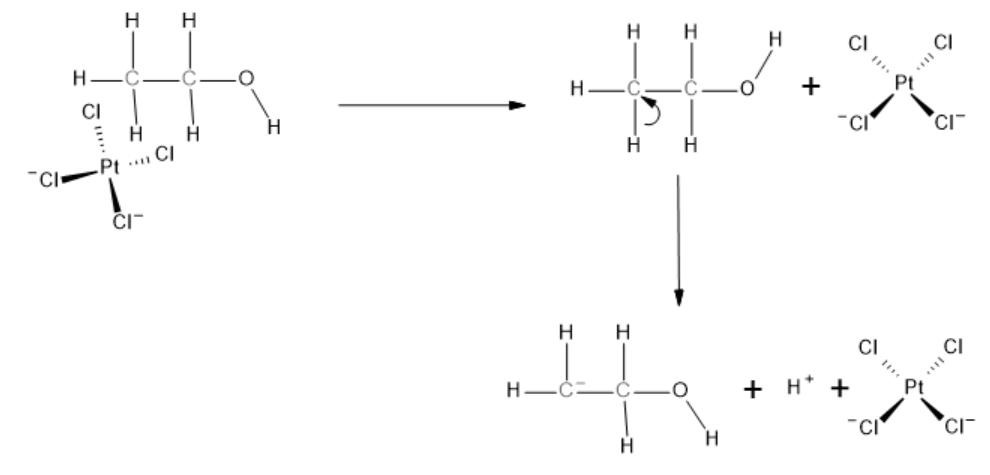
The filled dyz orbital of the platinum atom provides an area of high electron density and so exerts an attractive force on one of the hydrogen atoms in ethanol, thereby weakening the C-H bond. The high temperature means that the ethanol molecules have high kinetic energies, so when they collide, enough energy is transferred to break this weakened C-H bond heterolytically, forming a H+ ion and a carbanion [scheme 1].

Scheme 1 The mechanism for the breaking one of ethanol’s C-H bonds to produce a carbanion.

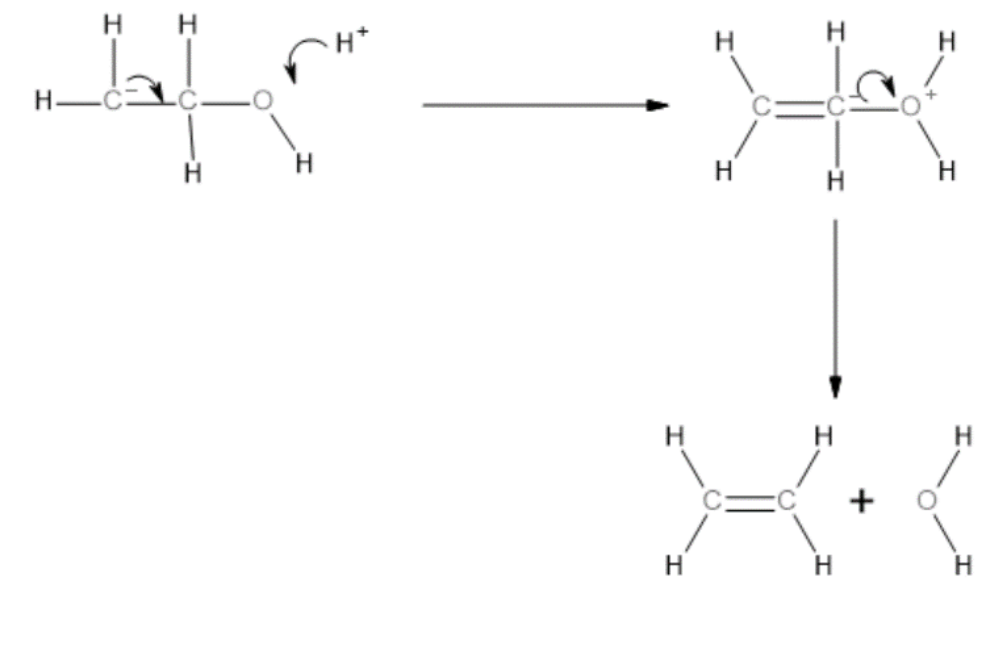
Then, a H+ ion produced in scheme 1 bonds with one of the lone pairs on the oxygen atom, forming a H2O group (which is a good leaving group). The lone pair on the carbanion then forms a bond between the two carbon atoms, creating a double bond; however, carbon atoms cannot have more than four bonds, so the C-O bond breaks and the H2O leaving group is released, forming ethene and water [scheme 2].

Scheme 2 The mechanism for the formation of ethene and water from the carbanion.

The second stage of this reaction is the substitution of one of the chloride ions in [PtCl4]2- for ethene. This is possible because the two Cl ions in [PtCl4]2- are ligands, i.e. bonded to Pt by a coordination complex, which makes them easy to remove in ligand substitution reactions.

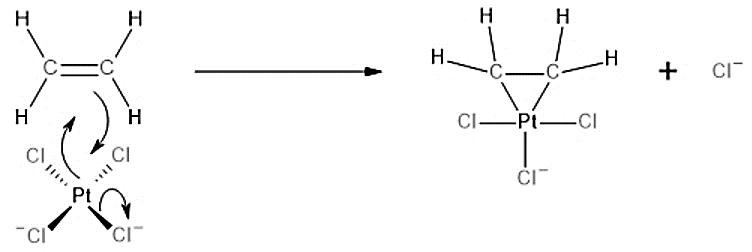
[PtCl4]2- consists of two chlorine atoms and two Cl ligands bonded to a platinum atom. Due to the large difference in electronegativity between chlorine and platinum, the Pt-Cl bond is very polar, giving the platinum atom a δ+ charge. The double bond in ethene is an area of very high electron density and therefore acts as a nucleophile and is attracted to the δ+ charge on the platinum atom. The double bond in ethene then forms a coordination complex with the platinum atom forcing one of the Pt-Cl coordination complexes to break, yielding [PtCl3(C2H4)] and Cl [scheme 3].

Scheme 3 The mechanism for the formation of [PtCl3(C2H4)].

There is a large yield of metallic platinum from this method of synthesising Zeise’s salt. This is due to a redox reaction that also occurs in which ethanol reduces [PtCl4]2- to platinum metal and is itself oxidised to ethanal:

[PtCl4]2-+ C2H5OH  Pt + CH3COH + 4H+ + 4Cl

This secondary reaction provides evidence for the mechanism that I have suggested because it shows that [PtCl4]2- plays a minimal role in the dehydration of ethanol to ethene because otherwise it would react in a redox reaction with ethanol rather than dehydrating it.

Infrared Spectral Analysis

Before considering the bonding in Zeise’s salt, we must first show that the platinum-ethene interaction in the molecule is in fact a bond and not simply a strong intermolecular force. The way that I will prove this is using the infrared (IR) spectra of Zeise’s salt and the reactants used to synthesise it. My logic behind this method is as follows: IR spectra show the different bonds present within substances – intermolecular forces of attraction do not show up on IR spectra

– therefore, if there is a peak present in the IR spectrum of Zeise’s salt that is not present in any of the spectra of the reactants, such a peak must be due to a bond that is not present in any of the reactants but is present in Zeise’s salt. The only bond in Zeise’s salt not present in any of its reactants is the platinum-ethene interaction. Therefore if such an inexplicable peak shows up on the IR spectrum, it shows that the platinum-ethene interaction is in fact a bond and not any other type of interaction.

The IR spectrum for Zeise’s salt in its crystalline hydrate form, which also contains waters of crystallisation, is:

(AIST spectral database)

Through the process of peak labelling by comparing this spectrum with the IR spectra of ethene, K2PtCl4, and waters of crystallisation (obtained from the IR spectrum for gypsum), it is now possible to determine if there are any unexplained peaks:

  • Peak A is due to the O-H bonds in the waters of crystallisation stretching.
  • Peak B is due to the merging of the peaks due to the Pt-Cl bonds stretching and the C-H bonds stretching.
  • Peak C is a weak signal that is due to the C-H bonds bending.
  • Peak D is due to the O-H bonds in the waters of crystallisation bending.
  • Peak E is due to the C=C double bond stretching (this is shifted right by around 150 cm-1 from the corresponding peak in the IR spectrum of ethene because of the interaction between the platinum atom and the double bond).
  • Peak F is due to the Pt-Cl bond stretching.
  • Peak G is due to the C=C double bond bending.
  • Peak H is a weak signal due to the Pt-Cl bonds bending.
  • Peak I is a weak signal due to the Pt-Cl bond bending.
  • Peak J is an unexplained peak.

Since there is an unexplained peak on the spectrum, this shows that the platinum-ethene interaction is in fact a bond rather than an intermolecular force. In fact, 406 cm-1 (the wavenumber of the unexplained peak) corresponds exactly with the universally accepted wavenumber for the platinum-ethene bond (Grogan & Nakamoto, 1966).

Bonding

The bonding in Zeise’s salt is a problem that puzzled chemists for over a hundred years after it was first discovered. In many representations, the platinum atom appears (incorrectly) to be bonded directly to the C=C double bond rather than to any particular atom.

To solve this problem, three chemists: Michael Dewar, Joseph Chatt, and L.A. Duncanson created a revolutionary new theory of bonding for transition metals, which is now known as the Dewar-Chatt-Duncanson (DCD) theory of bonding in their honour.

At the crux of the DCD theory of bonding is the action of both filled and empty d orbitals in the outer shells of transition metal atoms, which interact with bonding and antibonding orbitals of other atoms.

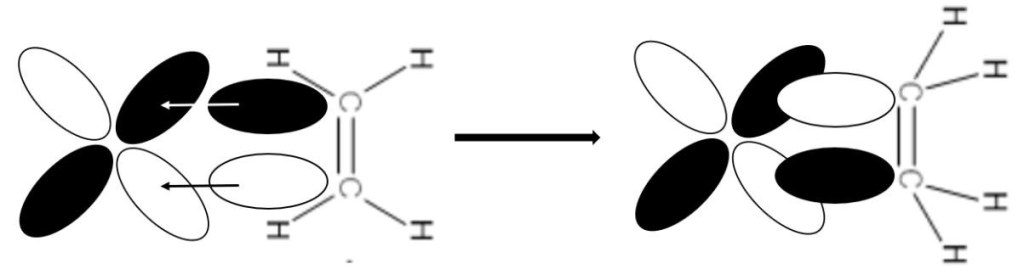
This is exactly what occurs in Zeise’s salt in a process called η2 bonding. The vacant dx2-y2 orbital receives electron density from the σ bonding orbital component of the C=C double bond in a process called σ donation. This creates a σ bonding orbital between the platinum atom and the two carbon atoms [scheme 4].

Scheme 4 σ donation between the σ component of the C=C double bond and the vacant dx2– y2 orbital of the platinum atom (black and white represent opposite phases of the orbitals).

The filled dyz orbital then donates electron density to the vacant π* antibonding orbital component of the C=C double bond in a process called π acceptance [scheme 5]. This creates a π backbond between the platinum atom and the two carbon atoms. Since an antibonding orbital is being filled, this weakens the C=C double bond, causing it to lengthen and its vibrational energy to lower – which is why the peak corresponding to the C=C double bond stretching is shifted to a lower wavenumber on the IR spectrum of Zeise’s salt compared with that of ethene.

Scheme 5 π acceptance between the filled dyz orbital of the platinum atom and the vacant π* orbital component of the C=C double bond.

This weakening of the C=C double bond due to the filling of the π* antibonding orbital also causes the molecular orbital to rehybridise from sp2 to sp3, which changes the molecular geometries around the carbon atoms from trigonal planar to tetrahedral. This causes the hydrogen atoms to move and face away from the incoming PtCl3 group (as shown in scheme 5).

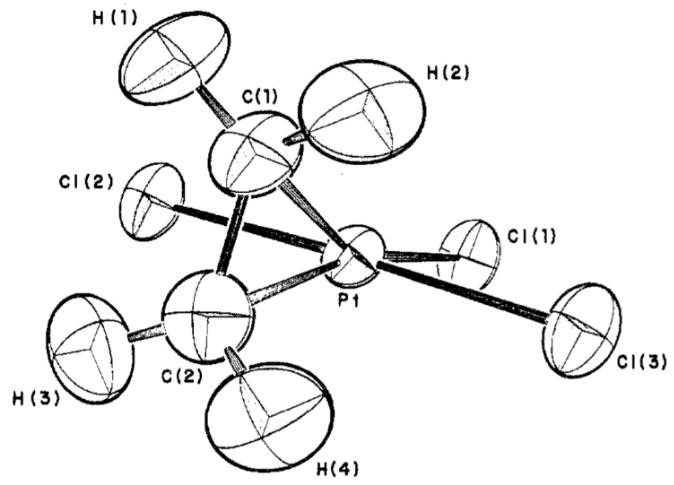
The bonding in Zeise’s salt is further complicated by a phenomenon known as the trans effect, which is that for molecules with square planar geometries, like Zeise’s salt, certain groups will remove electron density from, and thereby weaken the bonding of, the group trans (opposite) to them. This occurs in Zeise’s salt because the very electronegative Cl group opposite the ethene group removes electron density from the platinum-ethene bond causing it to weaken and lengthen – the platinum-ethene bond length in Zeise’s salt is 2.340 Å, while the Pt-Cl bond length is 2.303 Å.

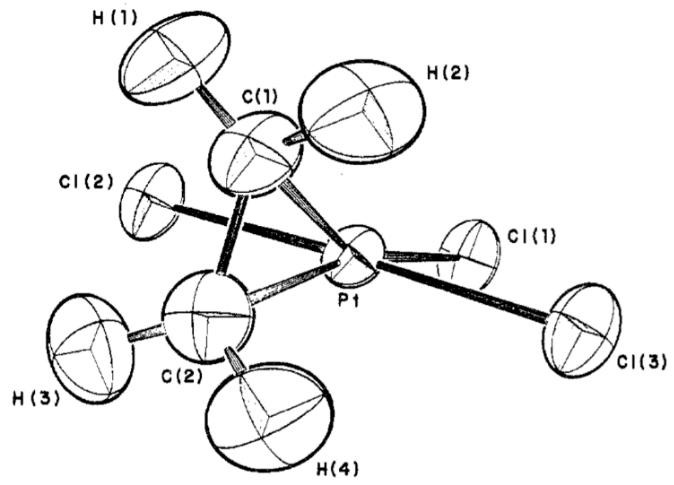
Once all of these bonding complications are considered, the final molecular geometry of

Zeise’s salt is:

Figure 1 The molecular geometry of Zeise’s salt (University of Boston, Massachusetts).

Importance of Zeise’s Salt

In 2015, it was discovered by researchers at the universities of Berlin and Innsbruck that Zeise’s salt can bind strongly to DNA. Although no full mechanism has been published, shown below is the mechanism that I think best describes the interactions that are occurring based on the reactions of similar compounds (such as cisplatin) and analysis of the proposed interactions involved:

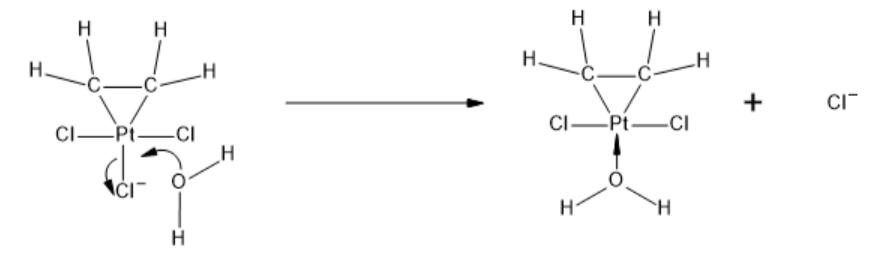
Upon entry into the cell, Zeise’s salt undergoes a ligand substitution reaction. Cl – as it is a good leaving group – is substituted for a water molecule to produce the dichloroaqua(ethylene)platinate(II) ([PtCl2(H2O)(C2H4)]).

Scheme 6 The mechanism for the ligand substitution stage of the reaction.

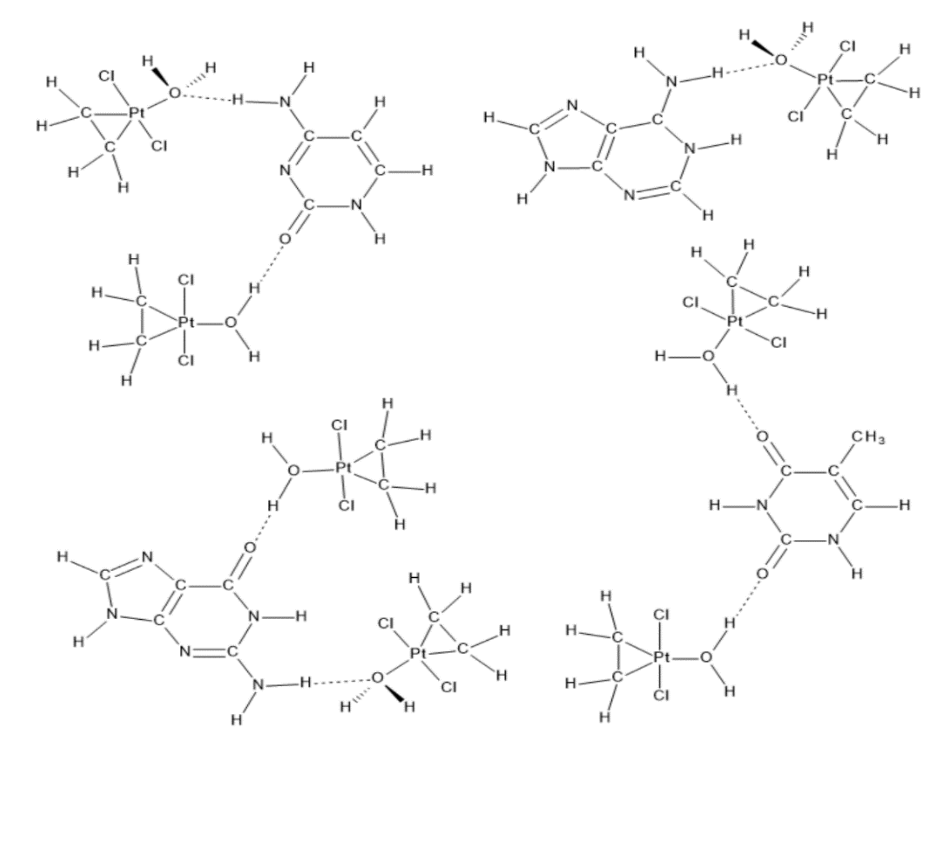
Now that there is a H2O ligand bonded to the platinum atom, [PtCl2(H2O)(C2H4)] can form hydrogen bonds with the four nucleobases [scheme 7] once the DNA double helix has been unravelled by DNA helicase at the start of the replication process.

Scheme 7 Hydrogen bonding between [PtCl2(H2O)(C2H4)] and (clockwise from top left) cytosine, adenine, guanine and thymine.

If the bases are hydrogen bonded to [PtCl2(H2O)(C2H4)], they cannot hydrogen bond to their complementary base. This means that the DNA double helix cannot reform and so no new DNA can be produced, which kills the cell. When Zeise’s salt is administered to cancerous tissue, by the above mechanism, the cancerous cells are unable to replicate their mutated DNA, which stops the cancer from spreading, and kills the cancerous cells. Although healthy cells suffer the same effects, since cancer cells replicate their DNA at a much higher rate than healthy body cells, the rate of death of cancerous cells is far higher than that of healthy cells.

Conclusion

William Christopher Zeise is one of chemistry’s forgotten heroes. It is amazing how some yellow crystals, made in a dingy laboratory in Copenhagen, have not only forged an entirely new branch of chemistry, but have also revolutionised the theory of chemical bonding. It seems like every time Zeise’s salt is looked at by scientists, it yields something new and important, and with the discovery of its possible use as an anti-cancer drug, it seems likely that Zeise’s salt has a bright future and will play an extremely important role in our society in years to come.

Bibliography

Balacco, G., & Natile, G. (1990). Formation of Platinum-Enamine Complexes by Reaction of Zeise’s salt with Secondary Amines. Journal of the Chemical Society, Dalton Transactions.

Bond, G. (1964). Platinum Metal Salts and Complexes as Homogenous Catalysts. Platinum Metals Review, 92-98.

Grogan, M., & Nakamoto, K. (1966). Infrared Spectra and Normal Coordinate Analysis of Metal-Olefin Complexes. I. Zeise’s Salt Potassium Trichloro(ethylene)platinate(II) Monohydrate. Journal of the American Chemical Society , 5454-5460.

Hunt, L. (1984). The First Organometallic Compounds. Platinum Metals Review, 76-83.

La Salle University. (n.d.). Introduction to Organometallic Chemistry 3. Philadelphia.

Meieranz, S., Stefanopoulou, M., Rubner, G., Bensdorf, K., Kubutat, D., Sheldrick, W. S., & Gust, R. (2015). The Biological Activity of Zeise’s Salt and its Derivatives. Angewandte Chemie, 1-5.

Merck KGaA. (2020). IR Spectrum Table and Chart. Retrieved from Sigma Aldrich Web Site:

https://www.sigmaaldrich.com

Seidl, V., Knop, O., & Falk, M. (1969). Infrared Studies of Water in Crystalline Hydrates:

Gypsum. Canadian Journal of Chemistry , 1361-8.

University of Massachusetts, Boston. (n.d.). Pi bonded ligands . Boston.

Categories
Lower School Poetry

Truth – Middle School

Winner of the Middle School Poetry Competition, written by third-former Finlay Sanders.

Estimated read time: < 1 minute

Truth is as eternal as time, 
Yet absent in many, 
As constant as the coming of season, 
Though rarer than gold. 

Behind one’s veil of darkness, 
Behind a screen of marble, 
An iron curtain, a false front 
Luxury oblivious and pure, 
A land of extravagance, 
Of poppies and charms, 
That hush and subdue. 

A life of lies; 
How sweet it is, 
A suppression of pain, 
Of honeyed roses, 
Of syrupy indulgence. 
So easy it is to forget, 
The undying thorns. 

The midnight seeds, 
like bullets etched 
Into the fleshy crimson petals, 
The many torn from society, 
Loathed akin to a blood-shod gash; 
The many ruthlessly killed, 
As victims of hate. 

How painless, how easy it is, 
To burrow under a coat of lies. 

By Finlay Sanders

Categories
Lower School Poetry

TRUTH – Lower School

Winner of the Lower School Poetry Competition, written by first former George Hewlett.

Estimated read time: < 1 minute

In the jungle of lies, everything is a mystery, 
opinions twisted, compressed, turned upon themselves in the darkness. 
Reality itself turned upon its head, tampered with, contorted and changed 
in the thick dense jungle of lies. 

It expands constantly, changing shape, changing form, whatever is necessary to achieve its will. 
Illusion, delusion, deceit, deception – these are all found in the jungle of lies. 

Now truth, a shining light, piercing the thick dense darkness. 
Illuminating all it touches, enlightening the shadows of uncertainty that were before. 
Nothing, in the end, can escape from the radiant touch of truth.  It will uncover the darkest secrets penetrating everything, regardless of time. 
Time is not a problem for truth. 
Like pure water, truth will infiltrate everywhere, even seeping into the mind. 
Nothing can escape the power of  

Truth. 

By George Hewlett

Categories
Arts & Humanities History Law & Politics Social Sciences

Irving vs Lipstadt- The Precedent on History

This article was written by sixth-former Omeet Atara.

Estimated read time: 3 minutes

In the case of Irving vs Penguin Books Ltd, the law was embroiled in a difficult case, which forced them to decide on the validity of a historical claim. Whilst it was labelled a libel case, this was a fundamental question about history. Experts included Richard J Evans were called to the stand to work as witnesses throughout the trial. The significance of this trial is not in the actual arguments, but the result delivered by the judge and historical judgements made.  

History is a complex subject and is about interpreting and understanding the past. Historians use a variety of primary and secondary sources to, put colloquially “work out what happened”. By using these sources, they can justify arguments and theories about past actions. However, historians do disagree and in this case, the argument was over the Holocaust. David Irving brought a British libel suit against Deborah Lipstadt and her publishers Penguin Books for claiming he was a Holocaust denier her book, Denying the Holocaust. Significantly, the case was brought in Britain rather than America, where Lipstadt was based; in British libel suit, the defendant holds the burden of proof whilst in America, it is the other way around. Hence, Lipstadt was forced to legally and historically show her claim about Irving was true. The mixing of historical information and legal complexities caused this trial to gain widespread media coverage within historical circles but also the academic media.  

The case itself was a bench trial and both sides hired high-quality reputable lawyers in what was not just a legal case but a defining moment in academic history. The lawyers for Lipstadt spent significant periods, with expert historians, trawling through the works of Irving. They were ultimately forced to prove that Irving was historically incorrect, and they did this by reading the footnotes. They would search through each of his sources and ensure that they represented the view Irving took. What they found was a group of misused and distorted historical sources. They were able to argue the comments by Deborah Lipstadt to be true. Therefore, this proof made the libel claim impossible to justify- it was not libel but academic truth. 

However, they also asked key historians like Richard J Evans to look at the work of Lipstadt and Irving to try and gain his expert opinion. This brings in the idea of historiography; which is simply the study of written history. He writes the book In Defence of History, which explores the value of history and historiography in the modern age. This has been a key debate at university and in academic history over how we should use this skill. As the expert witness, he concluded that Irving had been factually and intellectually incorrect in denying the Holocaust. He compared the reasonings and the factual evidence provided to make this judgement. He presented written and oral testimony to the court; he was also subject to a cross examination. This formed the basis of the Lipstadt defence which can be described as the justification defence. Rather than use legal escapism, she simply ensured her actions were shown to be fair and justified. 

Irving and his lawyers began with the advantage due to the burden of proof. However, the irreconciled actions of falsely manipulating sources inevitably caused significant difficulties when he came to argue his side. Ultimately, his defence was doomed because there was no libel case- what Lipstadt had said was blatantly true now that the sources had been explored.  

The judge delivered a crushing 397-page verdict in which he ruled in favour of Lipstadt and gave a damning report of Irving. They concluded him to be a holocaust denier, disappointing historian and the defence was entirely correct. This was a judgment that has set an important legal and historical precedent for the future.  

The law and history interacted in what was a case of incredible interest and importance. David Irving was proven to factually incorrect and it established the value of evidence in historical law. Despite the claim from Irving about the personal, economic and academic hardship he suffered the truth and history remained prioritised. The competition between historians over finding the truth makes it an interesting discipline. Regardless of the topic or personalities involved the history and evidence should come first rather than persona and economic disputes. Academic history which has a reliance upon evidence was strengthened once again. 

Further to this, the law was integrated with historical debate. Legally, the precedent was set for the value of evidence and removed the potential for other historical libel cases. This is a topic with no legislative agenda and hence the civil case uses precedent entirely. Hence, this ruling will be significant for years to come. The law also proved the strength of evidence no in academia but also in legal cases.  

History and law are both academic and complex subjects however and have been discussed and debate together in this example. The intertwining of topics has caused civil law to address historical issues; it is impressive to see how the law controlled and acted upon these issues. The Holocaust was a tragedy and to be debating abut its existence is disgusting- that is not the significant thought here. It is that the law sets a precedent for historical works on evidence, not personality.  

Categories
Arts & Humanities History

Slavery: A Catalyst for the Civil War?

This long-read article was written by sixth-former Jack Farrant.

Estimated read time: 8 minutes

The influence of slavery has long been considered to be the most important contributor to the start of the American Civil War. Historians since the days of the Civil War itself have often cited slavery as the primary, or even singular, point of tension. This view, although up to a point valid, is a gross simplification of what was in reality far more complex situation. The government of South Carolina, the first of eleven states to leave the Union, chose slavery as the main cause for the succession in their 1860 Declaration of Succession, saying that there was ‘increasing hostility on the part of the non-slaveholding States to the Institution of Slavery’. Although it is clear that the tensions of slavery were a factor in the outbreak of the Civil War, it is no doubt useful to also take a more Revisionist point of view. Indeed, while the divisive issue of slavery was a cause of tension among States, the problem of inherent disunity between those States encompasses much more than the dispute over slavery. It is more fitting to argue that it was the role of slavery within larger, more complex issues of economy, demography, and geography, that was more of a factor in the outbreak of the Civil War, as opposed to declaring slavery the sole source of tension. 

Historiographical debate over the last two centuries has provided the framework of modern opinion about the outbreak of the Civil War. For many years, it has been understood that the origins of the Civil War cannot be questioned without also looking at the wider context of international affairs and domestic tension within American society at the time. In addition to this, it is important to take into account the difference in opinion about the origins of the Civil War in Northern and Southern accounts. Especially in the years directly following the end of the Civil War, and into the Reconstruction Era at the end of the 19th Century, general Southern collective memory was that States’ Rights and Northern Aggression were the key factors in the outbreak of the war. On the other hand, Northern abolitionists, as well as the majority of today’s professional historians, point to the institution of slavery as the primary cause. 

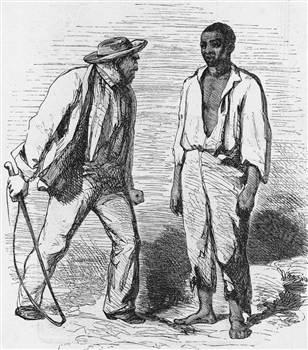
On the 20th August 1619, an English trade ship, The White Lion, arrived at Point Comfort near Jamestown, Virginia. It carried with it approximately twenty Africans, who became the first slaves to arrive in the British Colonies in America. By 1860, the slave population was four million. Although Revisionism is appropriate when considering the causes of the Civil War, it is still pertinent to acknowledge the importance of slavery as a source of tension. The uncomfortable question of slavery had remained unanswered since the early days of the Revolutionary War; a shortcoming of the revered Founding Fathers. Slavery had been practised in America for as long as it had been a colony, and so became a contentious issue in the new Union. George Washington, despite being a slave-owner himself, claimed that ‘There is not a man living who wishes more sincerely than I do, to see a plan adopted for the abolition of it.’ This duplicitous idea is at the core of early-Union hypocrisy over the morality and legality of slavery. The nationalistic sentiments of the Declaration of Independence and the United States Constitution affirmed ‘that all men are created equal’, but despite these claims, slavery would remain legal in the former colonies for the time being. In the years following the Revolutionary War, certain States began to prohibit slavery within their territory, creating a great divide within the Union. The politicians of the early Union were far more content to compromise than to take on the problem of slavery outright, a sentiment emphasised in the inclusion of the Three-Fifths Compromise, which decreed that each slave would be counted as three-fifths of a person, in order to increase House representation for slave-holding States. Further legislation, such as the 1793 Fugitive Slave Act, allowed for escaped slaves in free States to be returned to their masters in slaveholding territories. The sentiment of compromise rather than action confirms slavery as a cause for tension in America, and so it is clear that the response to early-Union slavery was an important factor in the lead-up to the Civil War.  

Political mismanagement of slavery no doubt also contributed to the inter-State tensions preceding the Civil War. Throughout the early 19th Century, a careful balancing act of slaveholding and free States in the Union was undertaken to ensure no side of the argument had majority representation in Congress. Just as had been prevalent in the 18th Century, a number of compromises were made to try and preserve the Union. The 1820 Missouri Compromise created the Free State of Maine to counteract the admission of the Slave State of Missouri, and banned all slavery in Louisiana Purchase territory North of the 36° 30’ parallel, excluding the State of Missouri. This was contentious legislation; contemporary writers such as ex-President Thomas Jefferson claimed that the division of the country along sectional lines would lead to the breakdown of the Union. Although the Missouri Compromise undoubtedly delayed the outbreak of war, Jefferson was proven correct just forty years later.  

The concessional nature of the legislation did nothing but delay the inevitable confrontation between North and South, rather than avoid it entirely. The Compromise of 1850 not only enhanced the power of the Fugitive Slave Act, but also defused a confrontation over slavery in the recently acquired New Mexico Territory. While this bill lessened tensions in the short-term, it was yet another example of compromise rather than pragmatism, and so did nothing in the longer-term to quell the confrontation. Further events such as the Kansas-Nebraska Act of 1854, allowing self-determination over slavery in the new States of Kansas and Nebraska, and the infamous Dred Scott v. Sandford court ruling, which devalued of the Missouri Compromise of 1820 by forcing Scott to remain a slave even though he had lived in free territory for four years, brought the country closer and closer to war, arguably dooming the Union to its impending division. It is clear that the lack of political pragmatism, and by extension the willingness to compromise, did nothing to stop the inter-State problems that had existed since the days of the Revolutionary War. In this way, political mismanagement of the institution of slavery caused just as much tension as the existence of that institution. 

For many years, the President of the United States has been one of the world’s most influential and powerful political figures, and is supposed to act as the defender of the Constitution and of liberty across the world. The position of President has, over American history, been held by some of the greatest leaders such as Abraham Lincoln, among many others. Despite this, the Presidency in the years leading up to the Civil War was not nearly as reassured or steadfast as it had been. The Election of 1856 saw Pennsylvania Democrat James Buchanan carry every Southern state. In his inaugural address, he left the question of slavery up to individual states, perpetuating the passive approach taken to slavery that was common at the time. Buchanan was a highly divisive figure, and as an advocate of the continuation of slavery, he alienated many Northern abolitionists. Some of the clearest evidence for the divisions within America was the election results in 1856. The divide between Northern and Southern States was obvious, with Buchanan winning every Southern State, and Republican candidate John Fremont, who arguably would have taken a more pragmatic stance to slavery, winning almost every Northern State. This was symbolic of the regionalised nature of American society in the years preceding the Civil War. The anti-abolitionist ideology of President Buchanan was generally popular among Southern voters, and highly unpopular among Northern voters. His politics, just like the Kansas-Nebraska Act, divided the Union among sectional lines. The Election of 1856 was a microcosm of a wider split in the Union; a situation getting closer and closer to Civil War. Overall, the influence of the Presidency during this time did nothing to quell tension within the rapidly failing Union. General historical opinion tends to disregard this factor of the Civil War, but it can be argued that the divisions of American politics were just as important to the start of the Civil War as the existence of slavery is usually considered to be. 

Ever since the early days of post-Revolution America, the issue of States’ Rights had been highly contentious, and the source of much debate among Northern and Southern politicians for decades. For decades, the split between North and South was obvious, encompassing economics, politics, and society. Many in the Southern States argued that Congress favoured the North, and despite being proven correct on multiple occasions, the feeling of dejection felt by many in the South fuelled inter-State rivalry in the Antebellum Union. The Articles of Confederation in the days of the Revolutionary War had allowed the central government little authority in the running of individual States, instead allowing the Union’s constituents to govern themselves on a self-determinist basis. The Constitution a few years later strengthened the government, decreeing that the Federal Law was ‘the supreme Law of the Land’. Despite these efforts to strengthen central government, the federalism present in the early Union meant that post-Revolutionary America was not much more than a loose confederation of individual entities. This lack of complete unity would continue to perpetuate through Antebellum America; it can be said that the Constitution itself split the country along sectional and regional lines, with each constituent member of the Union governing largely separately from the central government. The problem with federalism was most obvious in the early 19th Century, in particular regarding the Nullification Crisis of 1832. This event highlighted more than anything else the innate differences between the Northern and Southern States. The North viewed overseas trade as problematic, due to its industrialised and domestic economy. On the other hand, the much more rural and backwater South relied heavily on international trade, due to the larger emphasis on agriculture and exportation. In the late 1820s and early 1830s, Congress passed a series of tariffs that clearly favoured the Northern economy over that of the South, and the divisive Nullification Crisis began in 1832 when South Carolina declared the tariffs of 1828 and 1832 void within the State, prompting President Andrew Jackson to threaten military force. This brief showing of anti-Union sentiment turned out to be a precursor to the events directly preceding the Civil War, with South Carolina the first State to succeed from the Union in 1860. Overall, the existence of anti-Union sentiment in Southern States, and the popular Southern idea that the government favoured the North helped to fuel tensions between the constituent States of the Union, at the time a broad confederation of entities rather than a singular united body. The inherent split between North and South highlighted the single largest problem with creating such a Union; the political, economic, and social situations between the two sides of the country were so different. 

In conclusion, the influence of slavery in the outbreak of the Civil War cannot be understated. Its continued legality in some parts of the Union fuelled debate and division for decades after the Revolution, and in time tore the Union apart along sectional lines. However, from a Revisionist frame of reference, it is vital to understand that slavery as a part of American society was not wholly to blame for the start of the war. Indeed, the split legality of slavery based upon which State you lived in was symbolic of the innate problems within the early Union, as was the lack of pragmatism from politicians who were much more willing to compromise than to confront issues. The multifaceted split between the North and South was as much a problem of economy and society as it was slavery, with the Antebellum Union arguably trying to hold together what should really have been separate nations in first place. Regardless, the most important factor in the lead-up to war in 1861 was not slavery itself, but rather the divisions in the Union caused in part by slavery, and the half-hearted attempts to reconcile the problems of slavery. The fundamental differences between North and South, and the inability of politicians to effectively reconcile the problems caused by the division, is more influential to the outbreak of the Civil War American slavery itself. In the opinion of President Lincoln, the goal of the Civil War was to preserve the Union, not to end slavery, and so it is clear that the Union fell apart due to its own incompetence in dealing with slavery and other issues dividing North and South, not due to the outright existence of slavery in post-Revolutionary America.  

Categories
Features Law & Politics Social Sciences

Should legal disputes be decided by artificial, rather than human means?

Winner of the Trinity College Robert Walker Essay Prize, written by sixth-former George Hargreaves.

Estimated read time: 7 minutes

Artificial intelligence (AI) has the potential to resolve some legal disputes more accurately, and with greater consistency, than humans are able to. Practical advantages, such as speed and cost of resolution, have already led to its limited adoption in some countries. This is likely to increase as AI continues to evolve rapidly, both through development of the algorithms with which it is programmed and through machine learning. But it is unlikely at any point that AI will be able to update fast enough to reflect ever-changing and infinitely complex real world circumstances, or to master the (also ever-changing) linguistic subtlety upon which much legal argument is based. Many disputes involve unique circumstances which cannot be fully encapsulated by pre-set algorithms: human oversight will be necessary. Furthermore, AI’s inherent lack of transparency means that it will fail to meet the principle of open justice, except in limited circumstances: both users and subjects of AI may not understand the decisions it makes. This would risk society losing confidence in its legal system. While some disputes should be determined by AI, even these must be subject to human checks. In many cases, however, AI’s best use will be as an expert advisor (or “co-bot”, perhaps) for human arbitrators. Society is likely to consider it morally unacceptable for life-changing decisions (where the death penalty could be imposed, for example) to be made by a “robot judge”. Ultimately, law evolves to reflect changes in society and life itself; an inanimate entity such as AI will be incapable of comprehending the infinite complexity of life in the conceivable future. It would thus be mistaken to devolve all power to AI for deciding legal disputes.

Practicing lawyers have made increasing use of AI over the last decade. A survey of the websites of the UK’s 12 largest solicitors[1] indicates that this will continue, albeit with AI typically being used for back office functions and organising and categorising “Big Data” sources. It is often used for the retrieval of precedents for use in upcoming cases, for example, or for reviewing contracts. AI can perform many such tasks far more quickly, accurately and comprehensively than human solicitors would find possible. While programming and other costs are not insignificant, these solicitors all note that AI is allowing them to deploy more staff in areas where greater specialist skills are required, while automating more routine tasks. While AI has been contributing to dispute resolution for some years, it is now starting to come into use in the decision making process itself, having performed well in a series of robot v human contests. In 2018, for example, a LawGeex AI system achieving 94% accuracy in reviewing a set of non-disclosure agreements, compared with 85% by a group of legal experts in that field. Even more strikingly, AI took 26 seconds to review each agreement, while the humans required 51 minutes on average[2]. Cambridge-based Case Cruncher Alpha also had notable success in such competitions. In China, there are now over 100 robots in use in courts[3] while they have also been introduced in countries as diverse as Colombia[4] and Estonia[5]. However, their use remains limited to that of an advisor in high-volume, low-value cases, with a human judge in attendance making any final decision. Nevertheless, AI’s use here has clear practical benefits and may help improve the consistency of penalties or sentences being given. The UK too has recognised these advantages, with the Civil Justice Council recommending as long ago as 2015 the introduction of Her Majesty’s Online Court to resolve some disputes where the value is under £25,000[6]. However, the implementation of this has been delayed until at least 2023[7], partly due to the technology available remaining inadequate. This highlights the difficulties that the sheer complexity and holistic nature of many legal disputes poses AI.

The current usage of AI is limited to relatively simple and clearly defined situations, where organising known facts, which may not in themselves be disputed (in some divorces, for example) is what is required. There are many examples of “bots” being used outside the court system too – the donotpay.com site being one of the most well-known. Originally designed to help the public to obtain refunds for parking tickets wrongfully issued, donotpay.com has now extended its scope to help receive compensation where it is due from airlines, or to force companies to cancel subscription services when they seem reluctant to do so.

AI has some clear practical benefits which are leading to its increased adoption. While its capabilities are insufficient to deal with most decision-making tasks at present, the pace of technological change (estimated in Intel co-founder Gordon Moore’s “Moore’s Law” as a doubling of processing power every 2 years) should not be underestimated. It is clear that these capabilities will advance to a position where it could be used far more widely in future – at least theoretically.

However, there are overwhelming arguments against allowing AI alone to decide many legal disputes. These arguments may be classified broadly as practical, legal and moral.

Practically, an important difficulty is that the world is constantly evolving in unexpected ways and AI will itself need time to absorb and process new laws which may themselves be passed rapidly. In response to the coronavirus pandemic, a new UK Coronavirus Act was swiftly drawn up in early March and given royal assent on 25th March 2020. This will potentially lead to many legal disputes for which there are no precedents, and to as yet unforeseen consequences. Both programmers updating AI logarithms and machine learning will struggle to incorporate this new information in the short term. Similarly, programmers will more generally find it difficult to ensure that changes made to an AI system are not having unintended consequences on the algorithms which are already in place – particularly as the majority of programmers will not be lawyers. Neither will they be perfect individuals, so there is significant potential for their conscious or unconscious biases to be incorporated in an AI system (just as there are in any human system). Large and complex AI systems could also well be open to cyberattacks which have already led to major financial losses for many organisations; any such malicious attack on the legal infrastructure (possibly not identified for many years afterwards) could have extremely damaging consequences on the legal system.

The philosopher John Searle’s Chinese Room Argument[8] drew a distinction between the syntax and the semantics of language and argued that AI could never fully replicate human understanding. While AI may recognise words in themselves, it will always struggle to understand, or even recognise, the multiple linguistic subtleties upon which many legal disputes turn. In essence, many disputes are too complex to be simplified in digital format. If AI cannot understand arguments in their human form (instead merely simulating this), it is unlikely to be able to administer justice fairly to the satisfaction of the humans who need it. An analogy with the recent introduction of the Video Assistant Referee (VAR) in football is interesting as, even when rules were relatively simple and well understood, the attempt to implement them, using artificial means, has been widely deemed unsatisfactory and inconsistent by players and fans alike. VAR, applied strictly, lacks any capacity for discretion.

This complexity, and AI’s inherent lack of transparency, are at the heart of major counterarguments to its use in the legal system. Centrally, the principle of open justice – whereby the law should be clearly comprehensible to all, with decisions clearly communicated – is unlikely to be satisfied by AI, except in limited circumstances. Re and Solow-Niederman have identified “a range of concerns relating to [AI’s] tendency to make the legal system more incomprehensible, data-based, alienating, and disillusioning”[9]. Were this to be the case, using AI alone would in many cases very likely lead to society losing confidence in legal systems which it has used for centuries to provide an agreed framework for it to operate within. Another academic, Sourdin[10], notes “questions such as who makes the decision, and who possesses the legal authority to make such a decision. Is it the computer programmer, the policymaker, the human decision-maker or the computer or automated system itself” – these cannot easily be answered and raise further crucial problems, such as how and to whom appeals might be made.

Re and Solow-Niederman ask “can a prearranged decision procedure really incorporate an idea like mercy or develop fact-sensitive balancing of mitigation factors in a criminal case?” The principle of equitable justice might mean a recently unemployed husband stealing medicine for his sick wife could be treated more leniently than a drug dealer stealing drugs to sell on the street, when it came to a human judge passing sentence. Whereas AI, certainly for the foreseeable future, would not be capable of taking every extenuating circumstance into account. Particularly as every case will have unique surrounding circumstances; and the more complex the case the more complex those circumstances are likely to be.

But, even if developments in AI made it possible in the distant future to overcome all of the practical and legal issues outlined, there are critical moral problems which will remain impossible to solve.

The UK’s legal system (and that of most other countries’) has had human interaction woven into it ever since it was created, or naturally evolved from primitive, informal justice methods. This not only enables a judge to exercise discretion, or mercy, but it is also considered to be a fundamental right for litigants to be able to make their case personally – and to fell that they are being heard and understood. Similarly, a jury decision making process places much emphasis on human interaction and argument. If AI displaced all such human interaction, litigants would be likely over time to become disaffected, eventually losing faith in the system of justice itself.

Where very serious cases were involved, with very serious potential consequences (in some countries, the death penalty for example) it will be considered morally unacceptable for life-changing decisions to be made by a “robot judge”. It is inconceivable that the degree of technological development that would be necessary to overcome these reservations is within human reach.

Finally, privacy issues, both for individuals and for countries when national security matters might be involved, further complicate the landscape for AI. The extent to which these are concerning depends partly on political ideology: in China today, for example, all citizens are subject to “social scoring” based on their internet presence – with low scores affecting individuals’ rights to have a passport or to get a loan. This would be considered too intrusive in many other countries. In any event, AI may find itself denied information which it had in previous instances needed to make a fair decision. The withholding of information for reasons of privacy will continue to be seen as a necessary human “judgement call” – albeit clearly capable itself of abuse. This is an area where politics and law meet. The extent to which AI will improve in the future should not be underestimated. This will increase its use, which is currently limited to relatively routine, standardised tasks. Its ability to assimilate and organise data is already vastly superior to any human’s. However, it will always struggle to understand the linguistic complexity which is central to much legal argument, or the complexity of life itself, which is also often central to such argument. Without humans being part of legal dispute resolution, it is fundamentally impossible for the principles of open justice or of discretion to be met. Lower cost and greater speed will tempt rule makers, but AI’s most appropriate use is as an expert advisor to human judges.


[1] https://www.linklaters.com/en/insights/online-services/artificial-intelligence

[2]https://www.cicerosoftware.com/en/blog-robot-lawyers-lawyers-compete/

[3]https://www.worldgovernmentsummit.org/observer/articles/could-an-ai-ever-replace-a-judge-in-court

[4] https://www.garrigues.com/en_GB/new/artificial-intelligence-international-arbitration-legal-prediction-awards-issued-robots

[5] https://www.lexisnexis.ca/en-ca/ihc/2019-06/from-estonian-ai-judges-to-robot-mediators-in-canada-uk.page

[6] https://www.judiciary.uk/wp-content/uploads/2015/02/Online-Dispute-Resolution-Final-Web-Version1.pdf

[7] https://www.lexology.com/library/detail.aspx?g=10651420-b002-4626-8a01-4c88411be9ff

[8] In “Minds, Brains, and Programs” (1980)

[9] “Developing Artificially Intelligent Justice”, Stanford Technology Law Review 242 (2019)

[10] “Judge v Robot?” AI and Judicial Decision-Making”, UNSW Law Journal vol 41